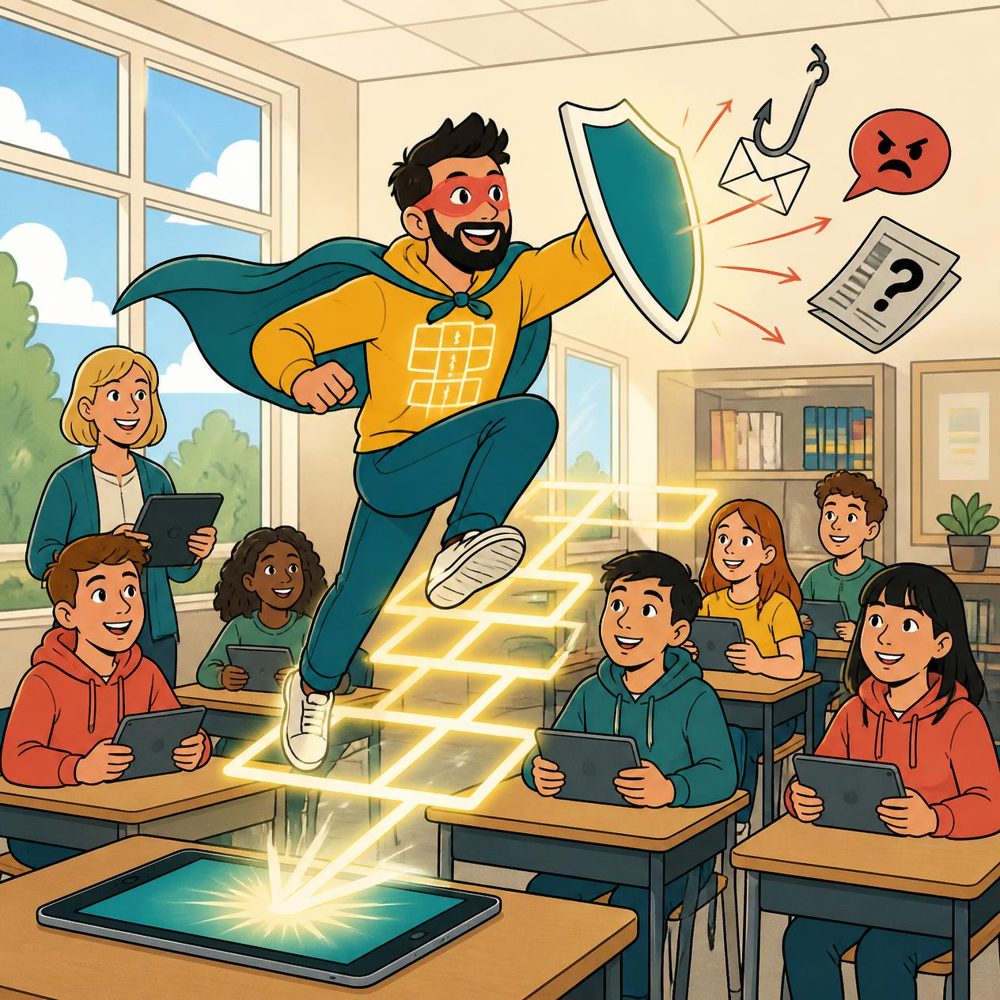
Pixel Shield
“Every level you play makes you harder to fool.”Dangers one tap away
Children and teenagers spend a big part of their lives online, where they can run into grooming, cyberbullying, fake news and phishing. Many don't recognise the warning signs in time, and some are at risk of becoming offenders themselves.
Learning by playing
RAYUELA turned research into a video game with six cyber-adventures. Police officers worked alongside sociologists, psychologists, anthropologists, lawyers, ethicists, philosophers, computer scientists and engineers. The stories draw on interviews with experts, child victims and offenders. Players' choices shape each story, and every answer lets them keep going, so they learn without being punished. The game is designed for classrooms, with an adult guiding the discussion.
Budget from CORDIS. The European Commission's news item lists €4,974,290 as the budget; CORDIS records it as the EU contribution, with a total cost of €4,978,040.
The team
- Lead: Comillas Pontifical University (Spain)
- Spain: Technical University of Madrid, Tecnalia, Valencia City Council, Zabala Innovation
- Belgium: Timelex, Ghent University, UC Limburg, ALL DIGITAL
- Estonia: University of Tartu, Police and Border Guard Board
- Portugal: Ministry of Justice · Slovakia: Bratislava Policy Institute · Latvia: Tilde
- Greece: Ellinogermaniki Agogi · Germany: NEC Laboratories Europe · UK: Police Service of Northern Ireland
What it achieved
- A video game with six cyber-adventures on grooming, cyberbullying, fake news and phishing, available in 13 languages.
- Tested by around 2,000 young people, with positive feedback.
- Used in Portuguese schools together with the Polícia Judiciária (Portugal's criminal police) as a prevention tool.
- Rolled out nationwide in Portugal for the 2024-2025 school year, with training and information sessions for educators.
RAYUELA, coordinado por la Universidad Pontificia Comillas, creó un videojuego con seis ciberaventuras para que niños y adolescentes aprendan a detectar el grooming, el ciberacoso, los bulos y el phishing jugando. Lo probaron unos 2.000 menores, está disponible en 13 idiomas y Portugal lo usa en sus colegios junto a su Policía Judiciaria.
Want to build the next one?
Find open EU calls on security & cybercrime on the Funding & Tenders Portal ↗, or see how EU funding works.
Check it yourself
- European Commission, DG Migration and Home Affairs: Project RAYUELA helps combat cybercrime through gaming
- CORDIS: RAYUELA project record (grant 882828: dates, budget, partners)
- Zenodo: RAYUELA open data set
- RAYUELA official website
Co-funded by the European Union. Hero illustration AI-generated. This page is an independent summary, not an official EU publication.